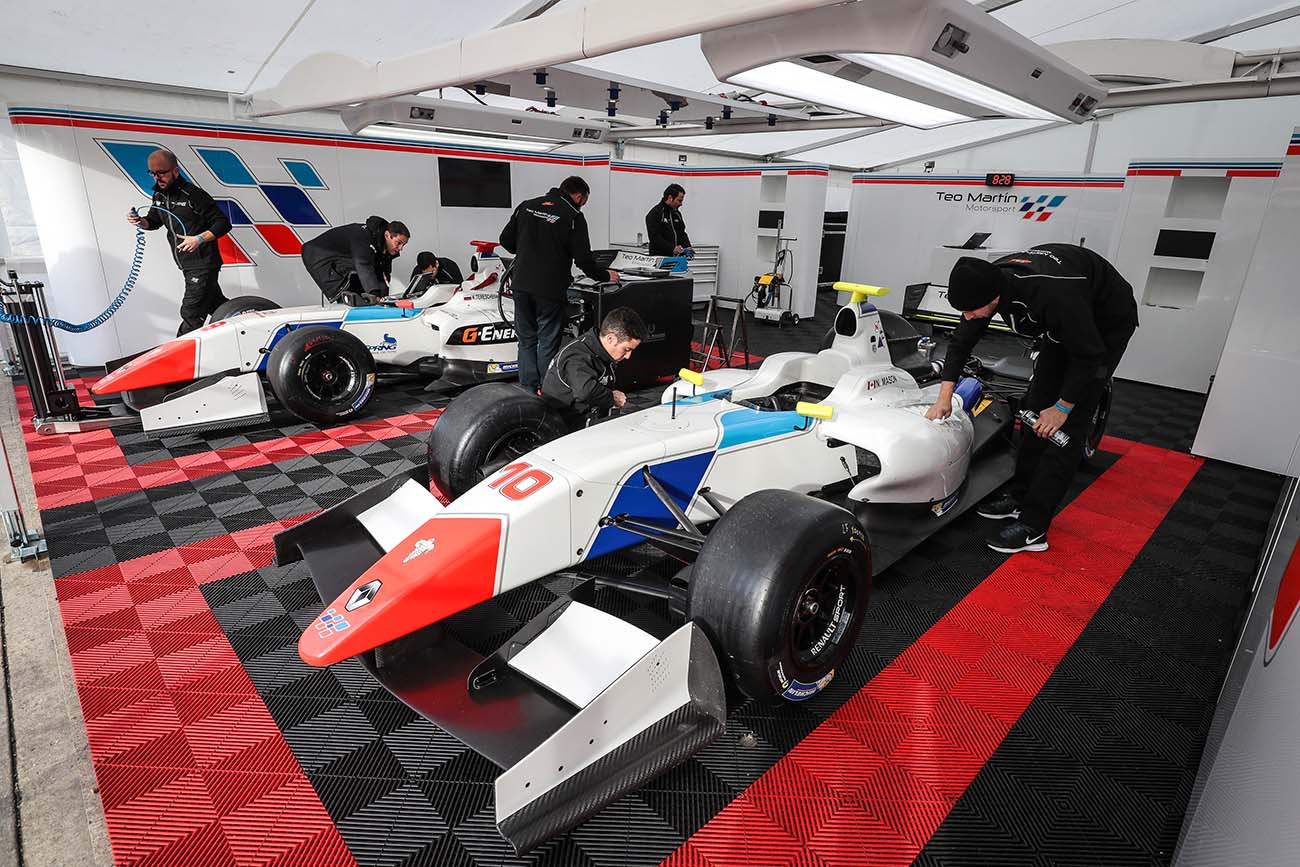
We also spoke with Julián Rodríguez, an engineer and simulation driver at the Teo Martín Motorsport team
Any sport can be practiced at many levels. It can remain a simple hobby, something to turn to occasionally as a distraction; it can be practiced regularly to compete and seek some form of self-improvement or personal goal, but within a more or less limited, controlled, and/or friendly competitive framework; or, on the other hand, it can be pursued with the dedication, resources, and tools necessary to compete professionally in open competitions, aiming to be the best or among the best in that discipline. But then, if you belong to the third group, it’s worth asking: what is the benchmark in simracing? What do simracing professionals who aspire to reach the top seek?
Springboard or an End in Itself?
In traditional motorsport, the steps and goals are clearer: “you’re born, you grow, you develop, and if you have the talent, money, the right environment, and luck, you reach the pinnacle, which is the WRC or F1.” Obviously, there are other top-tier championships to aim for, depending on whether we’re talking about Endurance, Touring Cars, etc., but broadly speaking, in motorsport, it’s clear what it means to aspire to the top.
The current challenge with simracing is that it’s still perceived as a means, not an end. Thus, the most common answer to the question in the first paragraph is that the ultimate goal for a simracing professional—be it a driver, engineer, coach, or simulator technician—is to stand out and secure an opportunity in real-world competition, which is why many see it as a springboard. However, the reflection I’d like to bring up today is that perhaps this answer is no longer so universal, and that the desire of many online professionals is increasingly to see simracing gain enough identity of its own to allow them to build their careers within this discipline, which, like traditional motorsport, has its own pros and cons but is neither better nor worse—just different.
A Shift in Perspective
While achieving that goal is a legitimate and commendable motivation that many simracing professionals strive for daily, the focus is already changing and will continue to do so. The underlying issue I’m raising is that the longing to reach conventional competition as the culmination of the simracing phase will lose its purpose as simracing gains the personality and maturity needed to become a specialty in its own right, ceasing to be merely a springboard and establishing itself as its own universe.
Comparisons are always tricky, and I won’t delve into debating the elements of risk, fear, danger, physical sensations, inertia, etc., that die-hard defenders of the phrase “nothing beats real competition” often cite. The mistake lies in trying to compare things that are, quite simply, different, even if they share a common core.
The Future of Simracing
Simracing will find its own personality when it stops being (and being seen as) a springboard to “real motorsport.” Professionals will emerge (and already are emerging) in motorsport who want nothing more than online motorsport—not because they can’t aspire to the real thing, but because they find their entire desired universe in the online realm. In a few decades, conventional competition will become so complex to organize, so costly, constrained, and inconvenient that this mode of racing will no longer be the golden dream most aspire to leap toward. That said, it will still take years for that to happen.
For now, what we’re witnessing is how eSports competitions, particularly those in the simracing sphere, are gaining followers and starting to take off, making an impact in the media and becoming news. They’re already a reality, and although their reach is still far from that of traditional sports and motorsport, all signs point to unstoppable growth in the number of users demanding to watch simracing broadcasts—a key factor in attracting the money and support needed to solidify its growth.
Separate Paths?
In my opinion, traditional motorsport and online motorsport should follow separate paths. In that sense, I must say I’d have preferred if F1 hadn’t gotten its “hands” on simracing, as we recently learned (link). Nor am I as thrilled as others to read that McLaren is partnering with iRacing to find the best simracer (link). Undoubtedly, these are two big pieces of news that help give simracing more visibility, but… taking it a step further, don’t you think they could, in the medium to long term, hinder its potential growth? For example, Microsoft, like many other large corporate groups, has always bought companies to absorb and take ownership of developments and technologies pioneered by others. These moves are made for various reasons, but one is to prevent those developments from overshadowing their own and losing some of the control they exert in their sector and their share of the pie. That’s why these moves by Liberty Media don’t sit entirely well with me. Setting aside speculations (call them conspiratorial if you like), what would have truly thrilled me is reading a headline like: “The automotive groups PSA, BMW, and Toyota, along with companies like Google, Tesla, Teo Martín Motorsport, iRacing, ISI, and Digital Bros, have teamed up to establish the FIAO (International Online Motorsport Federation). The goal: to create a regulated international structure for simracing and online competition.” Now THAT would have been a bombshell! I don’t think it’s necessary to explain why or the enormous implications it would bring.
Support for Simracing
Until that happens, any steps taken to support simracing are welcome. In that sense, it’s certainly appreciated that companies historically tied to motorsport are diversifying their commercial approaches and also supporting the development of ONLINE MOTORSPORT. This will enrich both worlds—traditional motorsport and the emerging online scene. If both sectors, TRADITIONAL MOTORSPORT AND ONLINE MOTORSPORT, compete freely for the market, the unhindered evolution of each branch will be optimal, ensuring benefits for everyone.
Simracing only lacks two things to fully take shape: an FIAO, or international federation (whatever they choose to call it), preferably independent of the FIA, to regulate the framework and rules of the game and drive its development and funding. And, in parallel, under that framework, the creation of a series of official, international, and standardized championships with guarantees to attract companies, teams, and investment. Championships driven by private companies or groups (like iRacing) are necessary, among other reasons, because they diversify the offerings and allow everyone to find their place freely. However, the world of ONLINE MOTORSPORT needs to establish its own official world championships to set the benchmarks that professionals aiming for the top in simracing should aspire to. In that scenario, the current FIA, F1, or any other traditional motorsport competition or organization becomes a potential competitor, as they’re taking a portion of the money simracing is aiming for.
Teo Martín Motorsport and Simracing
But let’s get back to the track. One of the Spanish companies making a strong mark and recognizing the importance of simracing as a motorsport in its eSports form is Teo Martín Motorsport (link). Just as any company entering a new sector seeks to hire the best to quickly understand the market and avoid missteps, Teo Martín Motorsport has brought on an engineer, Julián Rodríguez, as the organizational head of the online competitions the team participates in.
Teo Martín Motorsport began its journey in the 1980s. As they note on their website, “(…) the Teo Martín Motorsport team relaunched its activity in 2015 with a victory in the International GT Open with a McLaren 650 S GT3 driven by Miguel Ramos and Álvaro Parente. In the 2016 season, the team won the International GT Open teams’ title, grew in the EuroFormula Open with two podiums, and established itself in the World Series Formula V8 3.5 after purchasing the cars from the DAMS team that won the World Series in 2014 with Carlos Sainz Jr. In 2017, they defended the GT Open title and repeated success in the Euroformula Open and World Series Formula V8 3.5 (...)”.
Among other achievements and their undeniable love for the motorsport world, Teo Martín Motorsport has now ventured into national and international karting with their Junior Team and into eSports with their own simracing team, “Teo Martín eSport” (link). We can’t overlook their project to create the Sport & Engineering Center TM (link), which is nearing completion. This center, spanning over 15,000 m², will breathe motorsport from every corner and will house, among other things, a University Automotive Center, an R&D+I research center, a specialized vocational training center, a high-performance driver training center, and the Racing Car Museum. Undoubtedly, great news for Spanish and international motorsport.
Interview with Julián Rodríguez
Our protagonist today, Julián Rodríguez, is a driver well-known in simracing circles for years, with strengths including his speed and sharp mind. You can visit the drivers’ section of the website (link) for more information about him, but it’s worth noting that he was the Radical Challenge 2013 Season 3 Champion; Ruf Cup 2014 Season 1 Champion; GT Challenge 2014 Season 1 Champion; and holds the PRO/WC License for 2016 and 2017. When we learned of his move to Teo Martín Motorsport, we spoke with him, and he shared some details about his current work with the team, which I’ll summarize in an interview format:
How did the opportunity to join the Teo Martín Motorsport team come about?
Julián: I was finishing my engineering degree, and at my university, you need to complete an internship with a company before graduating. I knew exactly where I wanted to do it, and the first place I tried was Teo Martín Motorsport. Luckily, they accepted me as a simulator engineer.
How is the team structured, and what are your responsibilities?
Julián: Currently, at Teo Martín Motorsport, we compete in real life in the International GT Open with an M6 GT3, Euroformula Open, and Formula V8 3.5. We also have a Junior Karting Team and recently joined virtual competition under the name Teo Martín eSports. On one hand, I handle everything related to the simulator for the real team, ensuring the data aligns as closely as possible with real-world data and helping the drivers prepare for their races in the simulator. On the other hand, I manage the virtual team, where I serve as both manager and driver.
What’s the plan for the rest of the year, and are you already designing 2018’s strategy? What are the challenges?
Julián: Right now, we’re focused on iRacing. We’ll be racing in the special events organized by iRacing, the V8MGT from Mundo GT, and the qualifiers for the Blancpain World Championship. In the longer term, it’s hard to say exactly where we’ll compete, as the past few months have brought surprises in virtual racing (like the championship held by McLaren or F1’s own). Plus, Project Cars 2 and Gran Turismo Sport are coming out soon. While they may not initially be as pure simulators, we’ll need to see how they evolve and the impact they have.
How do you make a simracing team sustainable, and how do you see the future of the discipline? What challenges does your current team face in this regard?
Julián: It’s crucial that everyone on the team feels passionate about simracing because, despite being a sector growing rapidly, it doesn’t yet have the reach of other eSports, and it takes dedication and enthusiasm to compete at the highest level. Fortunately, more sponsors are betting on this world, providing significant support for teams and motivation for drivers. At Teo Martín eSports, we’re working to grow this virtual racing segment and give it the recognition it deserves.
How do you view simracing, not just competitively but as a casual fan? What aspects and values would you highlight to shape this unique universe of simracing mentioned at the start of the article?
Julián: I think it’s a fascinating world. It’s the eSport most similar to its real-world counterpart. The software used by racing teams to prepare drivers for real competitions is very close to what you find in the best commercial simulators. Yet, it’s a very financially accessible world, which leads to much higher competitiveness, resulting in closely contested and exciting races for spectators.
Do you think it will take long for this discipline to solidify as its own entity? What are the key factors that need to come together for this to happen?
Julián: I don’t think it will take too long. It’s true that from the outside, it might seem like people who enjoy or compete in simracing do so because they can’t race in real life. In fact, I and most simracers I know started for that reason. For it to solidify, it’s important first that we simracers believe in it ourselves, and then that brands get involved in virtual competitions. There’s still a way to go, but I’m convinced it will establish itself as its own entity.
In your opinion, who is the best driver currently in the national and international scenes?
Julián: Internationally, I’d highlight Greger Huttu for all he’s achieved and Frederik Rasmussen. Nationally, I think we have some great drivers, starting with those on our team, but if you look at the record, the answer is clear: Aday Coba.