
SIMRACING AND MOTORSPORT AT THE HIGHEST LEVEL
In this article, we will interview one of the greatest simracing experts at a national level, not only for his deep knowledge of physics and simulator setup, but also for his experience in real-world competition, having won countless races and championships. Currently, he serves as a coach for both real and virtual drivers. Joaquín Capsi is also the organizer of the Assetto Corsa “Cracs” community, where you can compete at the highest level with all types of cars and real/virtual drivers.
When did your passion for motorsport begin? Tell us briefly about your experience in real-world competition.
My passion for motorsport began at a very young age. My family is from Alcañiz, and by the age of 6, I was already eagerly awaiting race dates—it was like an obsession. Against my family’s wishes, I could only pursue it once I started working as an adult, beginning with the most accessible discipline, karting, where I won the Catalonia and Spanish Championships in my first two years, entirely as a privateer. After the European Championship, where I competed against over 180 drivers from around the world in France and qualified as a privateer for the grand final with just 30 drivers, I realized I needed to move to circuits.
I did so in single-seaters, equivalent to today’s GP3, but in Spain and with obviously lower performance than current standards. Without resources and again as a privateer, I stayed among the best for the four years I competed, fighting for the championship in my final year. At that point, I had to accept that, without support and at an age that made it hard to gain backing, I needed to switch to touring cars.
There was no better way to transition from karts and single-seaters to a bodied touring car than the most aggressive yet affordable single-make cup at the time. I only invested in races what I earned through them via sponsors or prize money from my results, so in more than one race, I had to battle the entire grid and fight for the podium with tires discarded by rivals at the back of the pits.
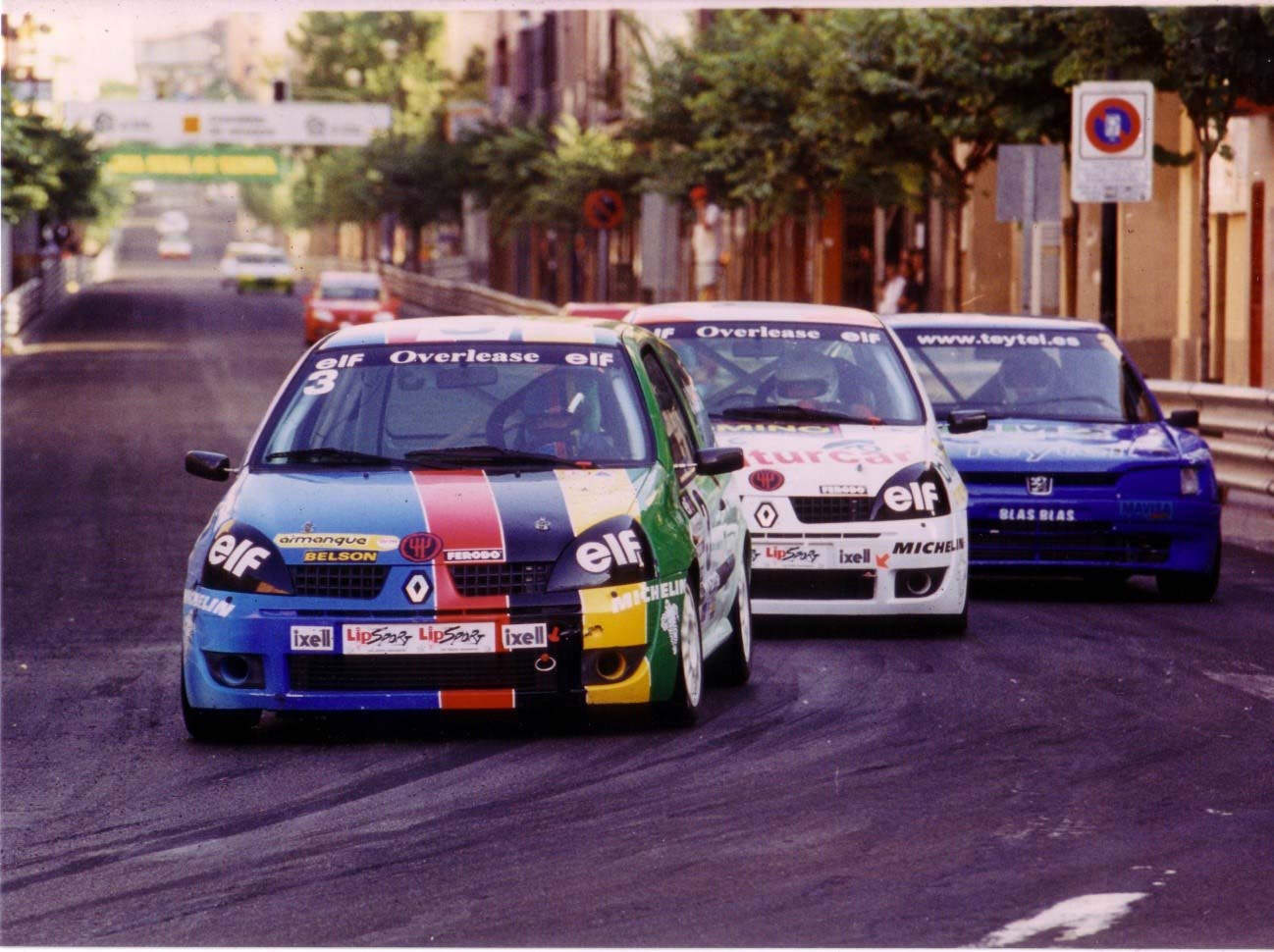
After mastering touring car racing in single-make series and securing enough wins to contend for the championship until the end, I took a step further with the most prestigious and competitive single-make series of the time, the Cliocup. I was involved in it for many years, as it coincided with my entrepreneurial venture of creating a team to work with other drivers. At the same time, I received offers for one-off races like the 24 Hours of Barcelona, where I started with a Honda Integra that I placed on the front row of the grid.
In 2014, it was time to move to GTs. I did so with my own team, winning the Spanish Championship with the Ginetta G55 GT4. Over these 32 years in competition, there have been countless podiums, victories, and championships, but above all, I value the vast experience gained from always being responsible—whether for better or worse—for the car I drove, tuning it myself. I also treasure the experience gained from managing, as a team, engineer, and coach, the races of world-renowned drivers like Jaime Alguersuari, Dani Clos, and Miguel Molina, among others.
Since when have you been using driving simulators? Which ones have been your favorites?
I’ve been using simulators (if we can call the oldest ones that) since I started in real-world competition, which is 32 years ago. Although the level of those simulators was little more than a game, I always configured the available options to make them as realistic as possible—or at least to demand something from me and contribute to real-world racing, whether it was concentration, reflexes, or race strategy. I remember Microprose’s Grand Prix as the first one, and it gave me a lot of what I mentioned earlier.
GTR was undoubtedly the best simulator until the current ones arrived. Whether it was rFactor, LFS, or console games, their realistic contribution was minimal, even though I dedicated a lot of time—especially to rFactor—trying to perfect them and find something useful for training, but it was far from what I needed.
Which simulator gives you the best sensations today?
Nowadays, simulators like iRacing, rFactor2, Automobilista, and even RaceRoom lack the essence of realism I seek. Only with Assetto Corsa have I found what I need to work with my drivers and myself—not without first making some personal tweaks to the cars, regulations, etc. However, its foundation is so solid that it allows me to achieve the level of realism that serves both drivers and engineers. Naturally, this required two years of mastering Assetto Corsa and creating mods to align it as closely as possible to reality within a simulator’s limits. So, without a doubt, Assetto Corsa is the only simulator today that offers me the sensations and demands of everything a driver and engineer need to know and learn.
What is your work as a coach for real and virtual drivers like? What aspects do you train with drivers in the simulator?
My work as a coach with real drivers is very broad and comprehensive, as my experience isn’t limited to just driving, as I’ve mentioned. As an engineer, telemetry expert, and team principal, I’ve had to manage myself or drivers who hired me as a structure throughout my career. So, to sum it up, my primary goal is to ensure the driver achieves their maximum performance on the track and their progress is always upward. This involves not only helping, teaching, or advising them on lines, driving techniques, and behavior on the track and in races with rivals, but also preparing them mentally and psychologically every day, teaching them to understand sensations and reactions to each maneuver while optimizing the car at all times, motivating or reining them in as needed, with the aim of achieving the best result. It also includes helping them focus and read the race instantly, assisting them in understanding telemetry with engineers or expressing themselves to improve the car’s setup, and finally, devising a race strategy and controlling it from the pit wall as the driver’s external eyes during the race.
In the simulator, with my goal of making it 100% realistic, I work on the same points mentioned above. We put everything into practice on the track, even with full race simulations, with the obvious difference that it’s easier and more feasible both economically and logistically.
What improvements have you recently noticed in simracing hardware?
The most significant improvement has been in peripherals—steering wheels, pedals, and gear shifters. As for the platform to run the software, PCs obviously advance every day, enabling them to execute simulators with the speed and quality needed for realistic simulation. Virtual reality is also progressing quickly, and while it’s still far from providing everything required, it’s starting to become something to consider for the not-too-distant future.
How do you see the present and future of simracing?
Simracing, like any activity conducted or exploited online, is a double-edged sword. The diversity of simracer profiles, goals, and needs is vast, and it sometimes mixes in a way that confuses new users, conditioning them with the overwhelming number of tutorials, tips, etc., online that are neither objective nor based on experience. This detail means simracing could either end up as it began (an entertainment or game) or truly become a professional tool (as I use it).
In fact, right now (the present), with the flood of hardware improvements and companies offering their products or services to simracing, there’s a volume of people getting involved as so-called experts without truly being so. But the business volume is starting to be sufficient for it to keep growing, allowing solid, expert companies to continue developing increasingly better products and services.
The future is clear. The future always looks to technological advancement, and simracing is a tool that relies on technology in all its components. So, it’s encouraging for motorsport enthusiasts or those of us who use it as a training complement, as it will surely improve every day. It will never replace real-world competition, but I’m convinced we’ll get closer to a level of professionalism and exploitation of virtual motorsport with organized, managed, and executed competitions like real ones, offering an alternative to this sport that’s so difficult to access in real life.