
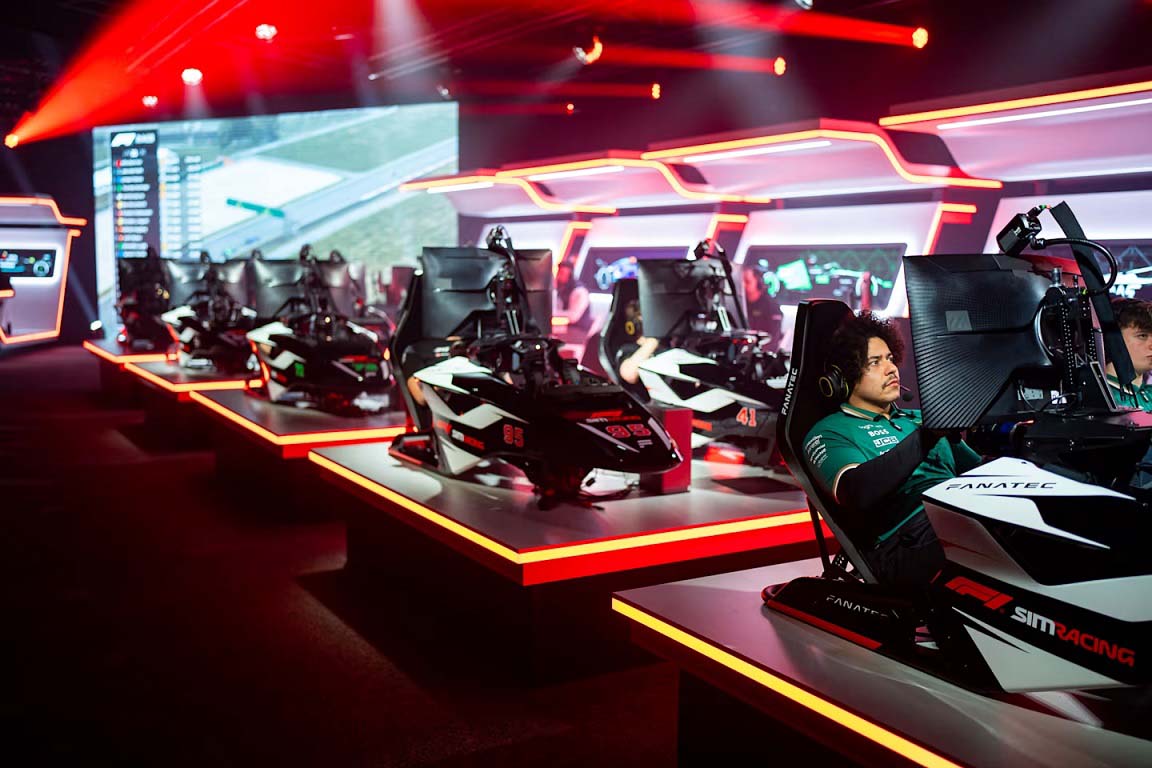
Simulation is gaining more followers day by day. This is why, although it may have started as entertainment, the technical advances in this specialty are transforming the game into a part of a professional driver’s activity. In this article, we will provide an introduction to almost all the concepts surrounding this hobby, which is gaining more followers every day and promises to stay strong, especially due to the upcoming gadgets that will be released in 2016 for the general public: notably the virtual reality headsets "OCULUS RIFT" and "HTC VIVE," which will take immersion in the simulator to a completely new dimension.
BUT WHAT IS SIMRACING?
This term encompasses two basic concepts: Simulated and Racing, or in other words, race simulation. For many years, almost all motorsport enthusiasts have wanted to emulate our idols or put our driving skills to the test in car games, whether on consoles or computers. We started with very basic games where the graphics were nothing special, and driving a car didn’t require much knowledge since the car’s reactions weren’t accurately simulated. Thanks to new technologies and advances in computing, we’ve reached a point where simracing is becoming increasingly realistic and comprehensive, allowing anyone with accessories like steering wheels, pedals, and shifters (H-pattern or sequential) to race against virtual drivers from around the world, with increasingly consistent car physics, incredible graphics and sound, and more detailed steering wheel sensations (FFB - Force Feedback).
PLATFORMS
There are two platforms where simracing comes to life: consoles and computers. It all depends on what each virtual driver is looking for. On consoles, the advantage is that you plug it in and play—you don’t have to worry about installing games or utilities, configurations, or adjustments. Plus, there are rooms or servers where you can race at any time. The big downside is that the physics can’t be fine-tuned as much as on a PC, and they tend to be more arcade-style games than true simulations. We call "Arcade" those games where the priority isn’t to emulate the real physics and behavior of the vehicle. But it’s on computers where the wide world of simracing opens up, allowing us to enjoy our races in a more realistic way. Here, we dive into a new virtual world where the focus is on emulating the car’s reactions, tire behavior, weather conditions, circuit scanning accuracy, complexity in car setup parameters, or high-level competitions with virtual drivers—many of which offer significant prizes. The only drawback would be the cost of having a mid-to-high-range computer capable of handling the simulator’s graphics, as well as the real-time physics calculations and opponents.
HOW TO GET STARTED IN SIMRACING
In reality, a low-end steering wheel and pedal set would be enough to get started. But if someone tries it and plans to stick with this hobby for many years, they’ll likely end up upgrading their accessories and buying or building a cockpit to mount all the necessary components. As the saying goes, "the ideal way is to build the house from the foundation, not the roof," so it’s important to have a comfortable, sturdy, and adjustable place to sit and drive. In this regard, we’re talking about a cockpit (whether low, mid, or high-end, depending on the user’s needs). Next, you should look for a steering wheel and pedal set that fits your budget and expectations. And, of course, a car seat where you can be comfortable during the hours spent in it. But it doesn’t stop there—if you want to keep improving your setup, you could add 1 or 3 screens, H-pattern or sequential shifters, handbrakes, tablets or HUDs to view car telemetry, button boxes, vibration systems, etc.
MOST POPULAR SIMULATORS
Today, we have a wide variety of PC simulators for all tastes—some with more realistic physics, others with incredible graphics, and others with highly professional competition systems. In short, there’s a simulator for every simracer (virtual driver). From Live for Speed and rFactor, the veterans and pioneers of this genre, to Game Stock Car, RaceRoom Racing Experience, and rFactor2 with its cutting-edge Force Feedback and physics, Assetto Corsa or Project Cars with their hyper-realistic graphics, or iRacing with the best-scanned tracks and a unique online system worldwide. But let’s not forget rally simulators, like Richard Burns Rally with its incredible physics, or the latest Dirt Rally, where the immersion is fantastic.
THE VIRTUAL ERA
And we can’t overlook the latest innovation that’s changing the concept of simracing: virtual reality headsets. With these devices, immersion reaches incredible heights because once you put them on, you no longer see the real environment around you (room, space, or hall). Instead, you have 360 degrees of freedom in any direction to see every detail of the car. But that’s not all—there are two very important factors that change the concept of driving in a simulator: 3D imaging and a real 1:1 scale. In the case of 3D imaging, thanks to the independent handling of the image each eye sees, the brain merges them to create stereoscopic 3D, giving us the depth effect we experience in everyday life. This means the steering wheel looks close, the dashboard farther away, the rearview mirror even more distant, and the track barriers or walls several meters away. On the other hand, the real scale provides unmatched immersion because you see the car at its proper size, the track at its actual width, and objects with their correct dimensions. All these variables make driving feel natural again—we no longer have to relearn as we did with 1 or 3 flat 2D screens and smaller-scale images.
HOW MUCH ARE YOU WILLING TO SPEND?
Perhaps this is the part that interests us most. As we mentioned earlier, it largely depends on the chosen platform, with the PC being more comprehensive, leading to a higher investment. The devices and the level of realism you want to achieve also play a role. The most basic setup for decent gameplay includes a seat or bucket, a steering wheel, pedals, one or more screens, a mid-range PC, and a structure to hold the seat and everything else. This setup would range between 750 and 1,500 €—naturally, this price would be lower if you acquire second-hand components or already own a PC. From this basic setup, the possibilities for expansion are nearly endless. For example, if you add lifetime body shakers and telemetry software (200€) and one of the more affordable motion systems, like a 2DOF system (1,500-2,000€), you’d get a simulator with incredible sensations, but the total cost would rise to at least 3,000 euros. If you go for motion systems with intelligent SCN5 control, the total price of all components would easily exceed 4,500 euros. The prices listed are merely indicative. In future installments, we’ll discuss the different elements and parts of a simulator in detail so you can figure out what best suits your needs. Lastly, a good system isn’t always the most complete or expensive one, but rather the one with the perfect balance of quality and price.